







You've probably seen it happen. Your child laughs at a message from someone you’ve never met, takes advice from a stranger in a game, or shares something personal without hesitation.
A quiet worry settles in your chest, not because your child did something “wrong,” but because the online world feels so much bigger than the one you grew up in.
Children are wired to trust. It helps them learn, connect, and grow. Online spaces, powered by algorithms and now artificial intelligence, take advantage of that natural trust in ways many parents never experienced as kids.

Trust is a strength, not a flaw
Before diving into risks, it helps to name an important truth: your child’s trust is not a weakness.
Trust allows children to:
- Build friendships
- Learn from others
- Ask for help
- Explore ideas with curiosity
In healthy environments, trust is how children thrive. The challenge today is that online spaces often pretend to be healthy environments.
How children learn to trust offline
In the real world, trust usually develops over time. Kids look for clues:
- Familiar faces
- Consistent behavior
- Shared spaces like school or sports
- Adult supervision
If someone behaves kindly and predictably, trust grows slowly. Online, those natural filters disappear.
Why the online world feels “safe” to kids

Screens remove natural warning signs
When kids interact face-to-face, they read body language, tone, and context. Online communication strips most of that away.
Without seeing facial expressions or hearing hesitation, children may:
- Assume friendly words mean safe intentions
- Miss sarcasm, manipulation, or pressure
- Feel less guarded than they would in person
A screen creates emotional distance, which lowers defenses.
Familiar platforms create false safety
Many online spaces feel designed for kids:
- Games with colorful graphics
- Apps used by friends
- Platforms marketed as “safe” or “family-friendly”
Even when parents set boundaries at home using tools like Apple Screen Time or Google Family Link, these spaces can hide risks that mirror common digital threats children don’t yet recognize.
The role of brain development
Kids are still learning judgment
The part of the brain responsible for impulse control and risk evaluation develops well into the mid-20s.
This means children:
- Focus more on immediate rewards
- Struggle to spot long-term consequences
- Are more influenced by emotions than logic
Online interactions move fast. Kids often respond before thinking through risk.
Social validation matters more than safety
For children and teens, belonging is powerful. Online spaces provide:
- Likes
- Comments
- Attention
- Instant feedback
Trust becomes the price of connection.
Why AI makes trust even harder to navigate
AI feels polite, personal, and patient
AI chatbots and AI-driven accounts are designed to:
- Sound friendly
- Remember details
- Respond instantly
- Adapt to emotions
To a child, AI doesn’t feel artificial. It feels like someone who listens.
AI never gets tired or pushes back
Unlike humans, AI:
- Is always available
- Never appears annoyed
- Never sets boundaries unless programmed to
This is one reason some parents rely on tools like Bark alongside real conversations.
The illusion of understanding
AI can reflect feelings back with ease:
- “That sounds really hard.”
- “I understand why you’d feel that way.”
Children may mistake mirroring for care.
Common reasons kids trust strangers online

| What Kids Experience | What Parents See |
| Friendly conversation | Unknown person |
| Shared interests | Potential manipulation |
| Feeling heard | Missing safety context |
| Instant connection | Lack of verification |
| Emotional support | No accountability |
Emotional needs drive digital trust
Kids aren’t looking for danger
They’re looking for:
- Friendship
- Validation
- Help
- Fun
- Belonging
Online trust often fills a real emotional need.
Vulnerable moments increase risk
Children are more likely to trust quickly when they feel:
- Lonely
- Stressed
- Bored
- Curious
- Upset with friends or family
Why warnings alone don’t work
Many parents say things like:
- “Don’t talk to strangers online.”
- “Be careful.”
- “You can’t trust people on the internet.”
While well-intended, these messages can fall flat.
Why kids tune them out
- The advice feels vague
- It conflicts with positive experiences
- It doesn’t explain how trust is earned safely
- It can sound fear-based rather than supportive
Kids need skills, not just rules.
Teaching healthy digital trust

Shift from control to connection
Instead of focusing only on restrictions:
- Ask questions
- Stay curious
- Listen without immediate judgment
Trust grows when kids feel safe talking to you.
Help Kids Learn What Safe Trust Looks Like
Talk about:
- Time (real trust grows slowly)
- Boundaries (safe people respect limits)
- Transparency (safe people don’t ask for secrecy)
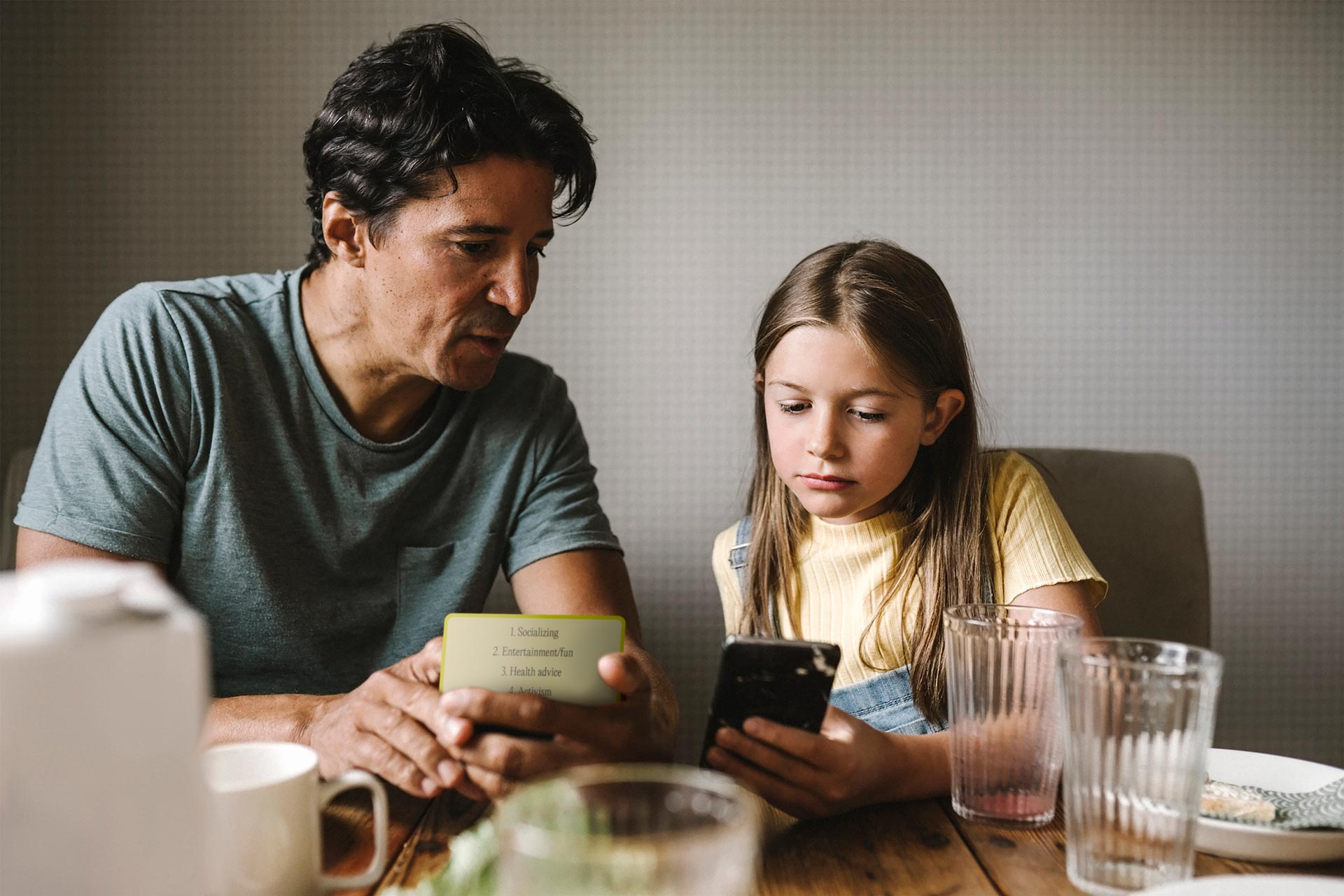
These ideas become easier to practice when families use Raising Digital Citizens conversation cards, helping everyday conversations slow down and giving kids space to reflect, regulate emotions, and feel heard.
Practical conversations to have with kids
Use real-world comparisons
Examples help:
- “Would you share that with someone you just met at the park?”
- “How long do you usually know someone before trusting them?”
Normalize mistakes
Let kids know:
- Everyone makes misjudgments online
- Trusting doesn’t make them foolish
- Asking for help is always okay
Shame shuts down communication. Safety grows from honesty.
Warning signs kids should know
Teach kids to pause if someone:
- Asks for secrecy
- Pushes emotional closeness quickly
- Requests personal details
- Offers gifts or rewards
- Tries to move conversations to private platforms
These are signals to check in, not reasons to panic.
Building digital resilience over time
Skills matter more than filters alone
Monitoring tools can catch risks, but they can’t teach judgment.
Kids need:
- Emotional awareness
- Critical thinking
- Confidence to say no
- Permission to step away
These skills protect children even when tools are turned off.
Model thoughtful online behavior
Children watch how adults:
- Share information
- Respond emotionally online
- Trust sources
- Handle conflict
Your digital habits teach more than lectures.
A final reassurance for parents

If your child has trusted someone online too quickly, it doesn’t mean you failed. It means your child is human in a system designed to encourage connection without pause.
The goal isn’t to raise suspicious children. It’s to raise awareness. Kids who know they can trust their instincts, ask questions, and come to you when something feels off.
Trust, when guided with care, becomes protection, not danger.
FAQs
Why do kids trust strangers online so easily?
Kids are wired to trust as part of healthy development. Online spaces remove many of the natural cues children rely on to judge safety, like body language and tone.
When friendliness shows up quickly on a screen, kids often interpret it as genuine care rather than potential risk.
At what age should parents start talking about online trust?
There is no single “right” age, but conversations should begin as soon as children start using digital devices.
Even young kids can understand simple ideas like privacy, kindness, and asking an adult before sharing information. These conversations grow more detailed as kids mature.
How can parents teach kids to be cautious online without scaring them?
Fear-based warnings often shut kids down. A more effective approach is:
-
Asking open-ended questions
-
Talking through real-life scenarios
-
Normalizing mistakes and curiosity
When kids feel safe talking, they are more likely to pause and check in when something feels off.
Are AI chatbots safe for kids to talk to?
AI tools are not designed to replace human relationships, even when they sound supportive. Children may struggle to tell the difference between emotional reflection and real care. Parents should treat AI interactions as learning moments and talk openly about what AI can and cannot understand.
What are signs my child may be trusting someone online too much?
Some common signs include:
- Wanting to keep online conversations secret
- Becoming emotionally attached to someone they have never met
- Feeling anxious when unable to access a device
- Defending an online relationship strongly
These signs are signals for connection and conversation, not punishment.